Monday, April 4, 2011

Ross Shirley Home - Teton Flood Disaster

This is a visual story of our family homestead and the effects of the Teton Dam Disaster on June 5, 1976. This is the view of the house from the northwest looking toward the south east with Sugar City in the background. The flood came from the left. It caved in the east side of Dad’s shed and took out the doors on the west as the waters went down. This is the back side of the house showing all the fence posts laid flat. Water was still running by, which proved to be a great help in cleaning up.


This is the view a little more down the same road to the south, looking toward the northeast where the flood came from. It shows Dad’s shed.


This is the view of the house from the corner, showing approximately where the flood victim’s body was discovered.


The waves in the water were either the current, or the waves caused from the wind.


This is another view moving around the corner to the east. Again, this is the general area where the deceased victim was found.


The ditch and the bushes created a gathering place for many mailboxes. Dad found a rocking chair high in a tree in Wilford and retrieved it. He gave it to me (Scott) and I still have it.


This shows Dad and several of the family after they had shoveled the mud out of the house and hung the carpets out to dry.


This is Dad cleaning out his house. The carpet was from the front room. While many people stood in front of their homes crying, Dad was busy working.


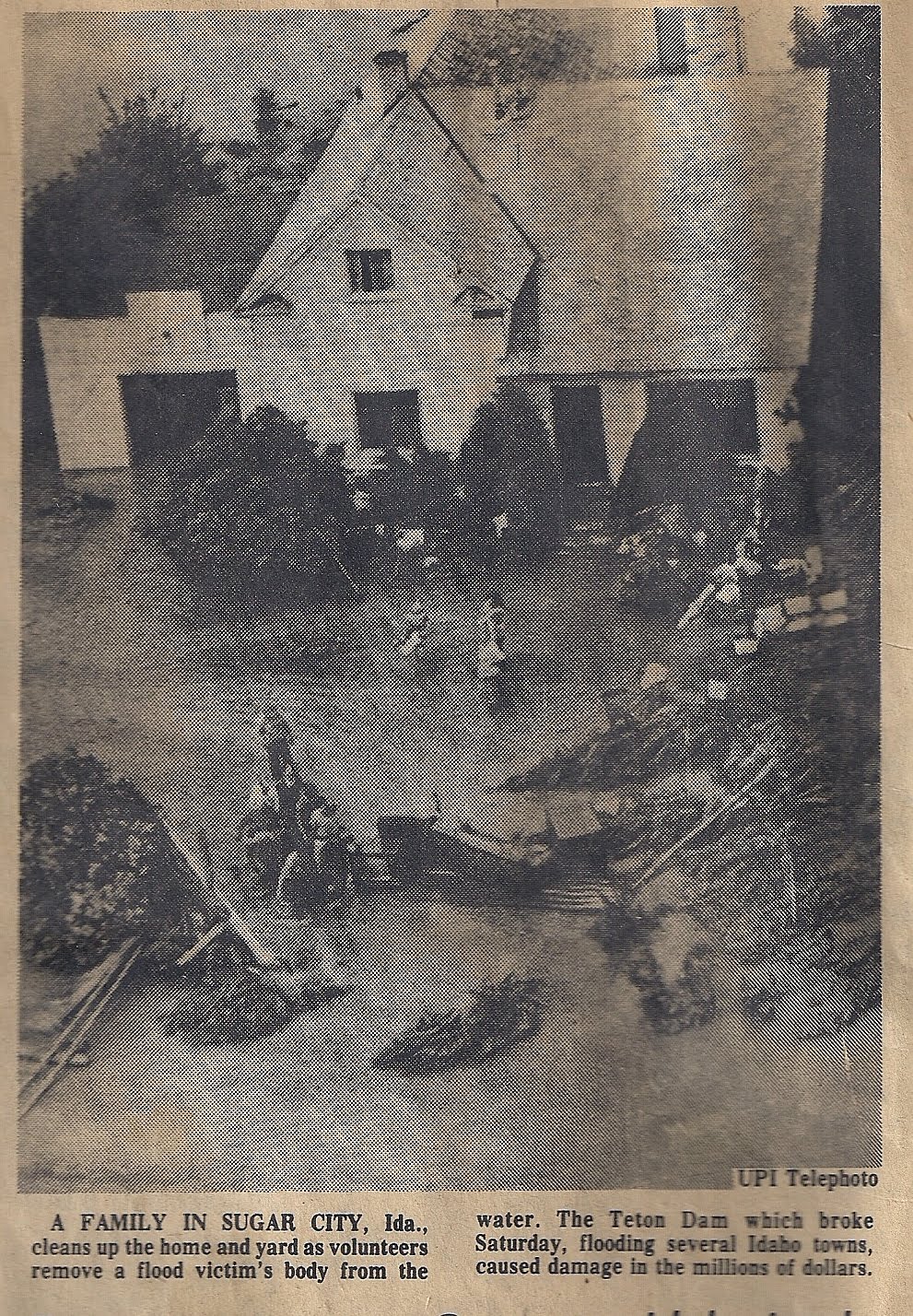
This is the view from the helicopter as the family carried out the deceased victim. It says, “A family in Sugar City, Idaho, cleans up the home and yard as volunteers remove a flood victim’s body from the water. The Teton Dam which broke Saturday, flooding several Idaho towns, caused damage in the millions of dollars.” It should be noted the family was the volunteer group.


This picture was taken a bit further to the east, showing the leaning power poles on the west side of the house.


The trees on the east side of the house did much to protect the home from the big push of water, which was about five feet deep. They also collected a huge amount of additional debris.


Perhaps these trees kept the house from being flattened, who knows? This is another view of the east side of the house.


This is a bit further to the east of the house looking back to the northwest.


Still further to the east, looking back at the house and metal building.


Someone’s combine was deposited a little to the west of the house. It may have been Dalling’s. The field to the east of the house was full of water for several days.


The house was soon cleaned up. A bus full of Mennonites from Canada stopped by to ask if Dad wanted help. He put them to work. We were told from our Stake President not to turn volunteers away. We were told, “You will be held accountable for blessings others would have received, had they been allowed to help.” Later, it was determined the house could not be saved. Dad's name was painted on the front for the demolition team. There were too many structural problems. All the effort was not wasted, it only brought us closer together.


A H.U.D. hut was moved in just behind the house. Notice how everything was cleaned up and hauled away. We saw many truckloads of dead horses and cows being trucked away. Neal and Dad salvaged a lot of the brick, windows, and other building materials from the condemned house. After so many wonderful years of service, the day came for the home to be demolished. A home is more than bricks, mortar, and boards. It is the sum total of the people who lived and loved inside. Home is where the heart is. Our home is forever.


Saturday, April 2, 2011

Teton Flood Story - By Scott Shirley

I had been working for Safeway in Idaho Falls and had requested and received a transfer to the Rexburg store. We were living in Idaho Falls and Jan was expecting our second child (Jeff), yet we decided to go ahead and move before the baby came. It was June 3, 1976. As we were driving north to Rexburg on our adventure, I remember thinking that life was going to change. I had no idea. (Note: Here are the "Flood Babies, Allison, Brian, Chris, Jeff, Amber and Jenna.)


We unloaded our things at our ground-floor apartment on main street in Sugar City, and spent the night with Jan's folks. The following morning, June 4, Jan went into labor. We went back down to Idaho Falls hospital, which was located near the temple, and were blessed with healthy baby boy, Jeff. We were so excited. I spent the day with Jan and Jeff, then went back to Kinghorn's. Jenna was 14 months old. The future was looking good.


The following morning was Saturday, June 5. I left Jenna with Grandma K and went to the apartment to get some things unpacked. I remember having a distinct feeling that I should just leave everything and go back to Kinghorn's. I tried to ignore the feeling, but it persisted, so I drove two blocks south back to Jenna and Grandma. As soon as I drove in the driveway Grandma K came out and told me the dam had broken. My thoughts went back to the floods of '62, so naturally I expected no more than a foot of water.


Earlier that morning, seepage was noticed on the north flank of the dam. It seems the water was leaking into the rock on the north side, gone around the grouted curtain of cement pumped into it, and was coming out on the west side. They brought some bulldozers to fill the hole, but the pressure on the other side was too much. Two dozers fell into the hole, later to be found a great distance downstream.


The water on the reservoir side had been rising at about three feet per day. This was a new dam that had never been filled. As it turned out, the spillway at the top never got a chance to be used. The photos here were taken by a lady who worked with my mother at the Forest Service. She gave Mom a complete set.


I hurried down to main street to see what people were saying and what was the plan. I remember thinking that things were going to change and wondered what would happen. Dorothy and I decided that we should stay together, so we left her car there, grabbed Jenna and headed for Brent's. We met Jean and the kids there and decided to ride together up to Rexburg Hill. We found a place in front of Lincoln Elementary. Dorothy and Jean stayed there with the kids while I walked north where I heard they needed help sandbagging the river bridge. When I got there I was told to go back up on the hill. They said that with the amount of water coming all the sandbags in the world would be of no use. I walked back up the hill wondering why I was not inspired enough to stay just one more day in Idaho Falls. As I sat on the hill with Baby Jenna and no diaper bag, bottle, or blankets, watching homes float away, I realized I was homeless. At the same time I was grateful that we had been spared. The wave came in from the north east direction. Huge columns of dust were being kicked up in front of the wave. At first we thought it was smoke. I thought there was no way Neal's house could be saved.


Dorothy and I were offered a place to stay at John and Shirleen Magleby's house. We were able to get some milk for Jenna. There was no way to call anywhere because phones were down. I walked to the National Guard station and talked to a State Trooper, telling him I needed to get word to Jan in the hospital that we were OK. He talked to some people and then made a radio call to Idaho Falls.


Jan had been sleeping that morning. When she awoke she was told the dam had broken. She turned on the TV. Reports were that hundreds were presumed dead, Teton and Sugar City were gone, and that Rexburg had been destroyed. When she got word from me she thought, "Scott would tell me that even if things were not good."


I looked out over the valley from Rexburg Hill with binoculars. As the sun was about to go down I could begin to see a few roads emerge as the waters receded. There were a few blinking rescue lights, but soon there were no lights at all to the north. It was surreal how dark and quiet things were.


I walked in the dark to the Manwaring Center to see what any news might be. As I walked across campus the screw in my glasses that kept the lens in place came out and my lens fell to the ground. What next! I entered the Manwaring and someone asked me what I might need. When I told him that I needed a paper clip he was puzzled. I used it to wire my glasses together so that I could see.


I went back to Magleby's who had prepared us a place in their basement. Grandma K suggested we have a prayer. I was wondering how I was going to get through the night with Jenna and no diaper bag and no binky. I thought I knew Grandma K, but I learned more about her through her heart-felt prayer than I had in all the time I had been associated with her. It was a prayer in which she genuinely talked to her Father in Heaven, pleading for help and protection for her family. I felt privileged to have heard such a prayer. When she finished, we settled down in bed. I held Jenna close to me. She had never gone a night without a pacifier, but that night was her first. We were blessed with peace in a most unpeaceful situation.


The following morning, Sunday, word came that we were to meet in the Hart Gymnasium. On the way there I saw Nile Shirley, my cousin. We were both concerned about Uncle Les. We found out later he had been in the tub when water crashed his house. He spent the night in a wet house with no electricity listening to distressed animals stuck in a tree.


When I got to the gym, someone had made signs for each ward in front of individual sections of the seats. The organization was calm and precise. I believe it was at this meeting (maybe a week later at a separate one) that President Kimball came to speak. First, Idaho Governor Andrus spoke. Then, President Kimball spoke. As he began, I was amazed at the true leadership he showed in comparison to elected government officials. I knew I was listening to a true prophet. He told us that he would weep for us if he thought it would do any good. He told us not to wait for the government to step in, rather pitch in and clean up. We were also told to document with photos, then go to work. He told us to do no more than a day's work at a time and not run faster than we were able. We were to be wise and maintain our health.


After the meeting, I snagged a ride in the back of a pickup that was going into Sugar. We went west along the hill to the Sugar cemetery at the foot of the hill. The bridge had been partially destroyed. There was a report that one of the new graves had been uprooted.


Huge sections of pavement were missing. There were no fence posts and few power poles. Army helicopters circled the area. Cylindrical granaries, still attached to their concrete foundations could be seen out in the middle of fields. The grain fields with stalks about six inches long, had been combed as if by a huge brush, all laid flat and pointing which way the water had gone.


I arrived at what was left of our apartment. The water had been about five and a half feet deep, but had now left about a foot of mud and straw on the floor. My belongings were there, but nothing was of use, except for my guitar, which had been on the couch, floated up to the ceiling, and did not have a drop of water on it. That is the same guitar Brandon now has.


I walked across what had been Sugar and headed for Mom and Dad's. The railroad tracks had been washed out. The rails had been bent around one of Dalling's big trees. When I got to the house it was locked, so I broke a window in the back door. I expected to find the parrot, Mrs. Bird, dead, but she just looked at me. The water had risen to the bottom of her cage and then gone down. I surveyed the situation and then wrote in the deep mud on the floor in front of the TV, "Scott was here, I have the bird." As I walked back into Sugar with the bird, I got some strange looks from people. I told them the bird had seen the entire thing, but wasn't saying much about it.


The following day I came in again by bumming rides here and there. There were people standing in the road with arms around each other crying and sobbing over their losses. Destruction was everywhere and the situation was grim, at least until I approached Mom and Dad's house. Carpets were drying in bushes and trees, furniture was moved outside. Instead of gloom and despair I saw family members joking while they worked. When I walked inside the house Dad said, "I heard you were missing." I said, "Yes, missing everything I have." We had a good laugh. Mom was in the kitchen making sandwiches out of the refrigerator which had been tipped over by the rising water. Their examples of optimism and good humor have always been an example to me.


I spotted Neal's trailer to the southwest, about half a mile away and decided to see what condition it was in. After I left Dale and Neal found the body of Mr. McCrae, one of the victims. Dale waded out in the water to see what it was as Neal watched. They told Dad they had found a body. There had been so much good joking going on that Dad did not take them seriously, but looking at their faces he knew it was real. He walked out to the man, turned him over and cleaned off his face with the water that was still running by a few inches deep. They did not know if they would recognize the man or not. I later asked Dad how he could so casually clean the mud from a victim's face with such tender care. He said, "If it were your body, wouldn't you want someone to treat it with respect?" Years earlier he and Rod had helped pick up the remains of a man hit by a train. Such stories helped me years later when I was trying to help a child struck by a car in front of Lyman Elementary. I thought, "I can't do this." The stories of Dad came to mind with the words, "If Dad can do that, I can do this."


I spent long hours working at Safeway, getting all the overtime we wanted. Safeway gave me a thousand dollars and the union gave me another eight-hundred. I had nowhere to cash my paychecks, but with so much help from the church and other volunteers we were OK. I went to the distribution center and reluctantly admitted I needed some clothes. They gave me a pair of boots and a few other things. All I owned I was wearing.


Shortly after the flood I was finally able to go and get Jan and Jeff. It was so good to see her again. Jan, Jenna, Jeff and I were together for the first time, homeless, but not hopeless. Magleby's helped so much until we were able to get a vacant student apartment on campus and later got a government HUD Hut. It was so good to spend some time with our new baby, Jeff. With all the chaos, he was a mild mannered, well-behaved baby. Jenna, who had been rather active and driving us nuts with her constant jabbering, suddenly became the ad-hoc mother. I really think she was under the impression that we had Jeff just to give her something to play with. We lived in the trailer court on Fifth West for about a year, then bought our home from John Magleby, across the road from Uncle Sterling.


It is not the things that happen to us in life, rather what we do with them. Our difficulties do not define us, rather they reveal our character. I will always remember the character of my family members during this very difficult situation, especially the leadership of Mom and Dad. They did not blink or falter, even in the face of great hardship. The Teton Dam fell apart, but our family did not. Each of our family members has had to go through very difficult trials, but never alone. All because of the quiet, calm, and humerous examples of Ross and Margie Shirley.


(Note: For a full list of those who died in the Teton Flood, as well as other information and photos, click on the link below. http://www.rootsweb.ancestry.com/~idfremon/flood.htm


Teton Dam Disaster, 1976, by Neal Shirley

Saturday, June 5, 1976, started out a beautiful day. We were planning to bless Amber the next day. Cathie was preparing lots of food for the special event. Brian was out in the yard playing with his trucks and our dog, Molly. That morning I was called in to repair a water main at what was then Ricks College. The water line was out in the median south of the heat plant. Davawn Beattie saw me working and stopped to tell me that the Teton Dam had burst. I jumped into my 1970 Chevy pickup and headed north. The sheriff deputies were stopping all traffic going to Sugar City, so I avoided them and went out through Salem to get to Mom and Dad’s place since they were in Salt Lake. I called Cathie to see if she was aware of the dam breaking. She had heard about it on KRXK. When she asked if I thought our place might get flooded, I suggested that she climb up on the roof. She saw no humor in that idea since she was still recovering from a C-section delivery of Amber.


I called Dad (who was in Salt Lake for Chris' blessing) to let him know. His first request was to get his Colt Python, a custom built target revolver. I could not find it, so I went out and parked the Bronco and the red pickup in the shop. I loaded their chest freezer into the back of my pickup, and decided to head north and see if the Teton River was showing signs of flooding. When I crossed the bridge everything looked normal. I unloaded the freezer at our place, and prepared to return to put stuff upstairs at Mom and Dad’s. Our neighbors, the Bodilys, stopped to see if we were leaving. I said that the river looked normal, and I felt like the flood would not get us. Paul pointed to the southeast, and we could see dust rising above the trees from the impact of the leading edge of the water about 1 mile away.


We decided to head to Cathie’s parents home in Plano, so Cath and I put Brian and 6 week old Amber in the pickup and we headed west. That route required that we also cut back to the south to get to the intersection at Lusk’s. We arrived at that intersection just before the leading edge of the flood. We saw the water about 100 yards from the intersection coming at us from the south and from the east. There were poles and debris rolling in the leading waves which appeared to be about 3 feet deep at the leading edge and tapering up from that depth. The water appeared to be coming at about 15 miles per hour. We saw horses in Lusk’s pasture running along the fence ahead of the wave, looking for a way out.


When we got to Plano, we listened to the CB radio that Vance had in his pickup. The report was grim. Word was that the water had taken out half of the Wilford Church, and had taken some shingles off of the church house roof. We headed back through Egin and Parker to get to Saint Anthony. There we saw the Bodily’s, who informed us that the railroad tracks had been washed up and over the highway, creating a giant picket fence. The dam created by the debris caught in this railroad track had turned the 10 foot tide to the south. Our road, 300 North, from the highway west, was dry. We took some pictures of houses floating away just a half mile to the south of our house. We had resigned ourselves to the probability that our house and car and dog and everything would be gone. What a blessed surprise to find all well at our place.


We now had a headquarters to work from when Dad and Mom and family got here. We had access to Mom and Dad’s house by driving as far as Hirschi’s, and then walking about a mile south from there. The bridge was still in place, but we had to climb up and through a lot of debris stacked up where the water had washed out the approaches to the bridge. We packed in chain saw, gas, shovels, and other stuff needed for cleanup. The mud and crud and destruction and quiet created such an unforgettable, surreal setting. We were surrounded on all sides by destruction. Yet is was a miracle that so few people died. If the flood had hit during the winter or during the night, hundreds would have perished. If it had hit our place, we would not have had our headquarters for everyone. We were happy to find Scott’s message in the mud indicating that he was OK. Mud etching was one of the few means of communication.


I retrieved the Kawasaki 100 dirt bike from where it laid mostly buried in the mud, and cleaned out the water and crud. It started, do Dad and I took a jaunt west and south to see what shape Salem was in. Uncle Fred’s big house had floated away, but his barn was still there. A couple of times we had to cross deep washouts in the road by crossing on a plank. I walked the Kawasaki across, which was tricky.


When the east wall of Dad’s shop caved in, water tried to exit through the west door. The door cables and buckled door kept most of the stuff in the shop from being washed away. The garden area probably resembled a kind of whirl pool as the water rushed around the house, trees, and shop. That’s why mud and mail boxes and such ended up there. The foot deep, sticky mud which settled in the garden area remained under about a foot of water for about a week.


As the water level began to subside, Stretch and I noticed something sticking out of the water about 30 feet west of the driveway. I didn’t want to trudge out in that sticky mud, so Stretch decided to check it out. When he got close, he got a sick look on his face. He could discern that we had been seeing the boot of a flood victim. It was a man by the name of McCrea who had been helping the Daw family in Wilford. We heard that they had been watching for the flood to come from the Teton River to the south of the Daw home. They were trapped when part of the flood went north up Hog Hollow and came upon them from behind. It took about six of us to carry Mr. McCrea out to the road since his clothing was so full of heavy, dense mud. About a week later another body was found in the canal a half mile to the west near Vernon Mortensen’s place.


East of Dad’s place the canal banks had been washed out, so we continued to have water running through the yard for a week or more. This provided some rinse water to help clean up some of Mom and Dad’s stuff. Dad had a cub cadet riding lawn mower which had a blade for the front. I got the tractor cleaned up well enough to run, and we used it to push the foot deep mud out of his shop. Dad and mom stayed at our home for a month or two, then found an apartment in Rexburg near campus.


When they got a HUD hut (Housing and Urban Development trailer), they stayed in it at their place for about a year until the Feds and the State could decide who owed Dad what. Dad and Mom built a new home in Wilford, a quarter mile east of our home. We had some framing/wall raising family building days. Everyone pitched in to construct the home, put down the well, pour concrete, etc. A year later Dad did the brick work, and I was his hod carrier. Dad hired a mover who loaded the 40X60 shop onto axels in one piece. They hauled it up highway 20 and delivered it at about 6:00 a.m. one morning. It completely filled both lanes of the highway. This whole area was a dust bowl the summer following the flood. Stinky silt covered every farm and field. The summer was dry and windy, and the sky was brown most of the time, especially in Wilford.


The Teton River bridges north of Teton were washed out. The Wilford church house had a huge hole in the east wall where the stage was. The flood waters went right through the recreation hall. The relief society had a tied quilt on the top shelf in the highest closet in the building. Water got up to it, but didn’t get it wet. Kind of like the parrot at Mom and Dad’s. They now refer to the quilt as the “miracle quilt.”

The Pre-flood Floods - By Dale Shirley

It was great to get the pictures that Scott sent me of the floods we had before the Teton dam was built. I didn't know the pictures even existed but I glad they do. With the full realization that I am now a senior citizen and subject to senior moments, I decided to write down what I remember of the floods. Hopefully the years haven't distorted too many of the facts. I remember two separate times that the floods surrounded the house.


It seems that the first one was the worst, but it could be that I was just older when the second one hit. My memory of the first one starts with a warm day in the spring of a very cold winter that had a lot of snow. There was a warm wind blowing out of the south and the playground at school became a sea of slush that we played in for a while until we got wet and cold. The wind was very strong and I remember sleeping upstairs and listening to it rattle the shingles as we went to bed. I remember being awakened in the early morning hours by mom. As we got dressed we could hear noise outside and looked out the window to see a National Guard dump truck dumping sand in the driveway. We went outside and helped dad build a barricade around the entrance the basement. It seems like we had a no sandbags so the barricade was built with straight sand around the steps to the basement.


It was still dark when I went back to bed and I slept late. As I woke up I noticed that the wind had stopped and it was light outside. As I looked out the house was completely surrounded by water. It seemed weird that it was so quiet and peaceful. I went downstairs where mom cooked us some breakfast and we watched dad sloshing around in some hip boots and tending to the dam and other concerns around the house.


I soon got bored hanging around the house so when I heard dad was going up the road, Neal and I went with him. We walked up towards Sugar and then followed the railroad tracks up to the overpass. There we found a source of our problem. The ice in the river had broken up into big chunks due to the quick thaw and because the railroad bridge and the road bridge were close together, the ice chunks had become clogged in the pilings of the bridges and were forcing the water out of the channel. There were a group of National Guardsmen there working on the ice. They had one of the men who was a bit heavy set standing out on the ice dam with a crow bar in his hands and a rope around his waist so he wouldn't fall through the ice. He would chip away with the crow bar in the ice and I remember the sweat just rolling off of him as he worked. When he would get a hole down a few feet in the ice they would put some dynamite that they had down the hole and put some sand bags on the hole and set it off. It would blow the sandbags up in the air and accomplished little else. We watched for a few minutes and then dad told us to come on and we went back down the tracks into Sugar City. We went to a house and as I remember, dad called him Stub Sondregger. Apparently dad knew this guy had some experience with explosives and dad convinced him to come with us. We went back up to the bridges and if anything, the situation was worse than when we left.

Dad went over to the National Guardsmen and probably with his connection as the Reserve unit CO, convinced them to let him give it a try. I don't think he had to talk very hard since I suspect that they were pretty discouraged with the progress they had made. Stub took a handful of dynamite sticks and wrapped them together and inserted the blasting cap. They walked along the banks of the river and found a place where an eddy in the water indicated that the water was moving down under the ice. They then pulled out several arm lengths of cord and then threw the dynamite in the eddy and fed out the cord and when it pulled tight he knew it was down under the ice. We all moved away from the river and took refuge behind a billboard that was beside the road. We were told to stand with our backs to the billboard and put our fingers in our ears and they set the explosion off. I got my first lesson in physics when they set it off. I learned that shock waves travel faster in water than they do in the air. We were standing knee deep in water and when the charge went off, it felt like two giant hands gave my legs a squeeze under the water and I just about jumped out of my boots. But then the sound of the explosion hit and it was the kind of boom that pounds on your chest and just about knocks the wind out of you. That was followed by rain as a mist of water came falling down all around us. Even though I was standing with my back to the blast I could see chunks of ice and debris splashing down into the water well beyond where we were standing.


When we were given the all clear, we looked around the sign and the sight was impressive. Huge chunks of ice had been lifted out of the channel and were piled on the bridge and banks of the river. I remember thinking that it almost looked like a giant birds nest. The National Guardsmen were pleased with the progress that had been made and grouped around dad and his buddy as they set up the next charge and they repeated the process again. This time we got near the end of the sign and peeked around as they set off the charge. They must have gotten the charge too close to the bridge because it looked like the whole bridge jumped when they set it off. Maybe it didn't but it sure looked like it.

As we walked back to the bridge, we could see that the remaining ice against the pilings had been pretty well shattered and was beginning to wash through the pilings. We left the National Guardsmen to handle things from there and walked back down the tracks to the Salem highway where we parted company with Dad's buddy and walked back to the house.


The only other thing I remember about the flood is being really bored, so we would go upstairs with dads .22 and look through the scope at chunks of wood floating by the house and when we found a mouse on one of them we would shoot at them. I rarely hit one, but cruel as it sounds, the shot would usually knock them off the raft so I would follow the rodent as he swam around looking for something else to climb up on, and when he did, I would shoot at him again.


The other flood I remember was the one that came a few years later. I found out after dad had left that he had gone up to the overpass again so I took off by myself to see if I could catch up. As I got to the tracks I could see some men walking along down the track so I assumed it was Dad and took off trying to catch up. I came to a spot where the railroad ties had been pulled out from under the rails and the water was flowing under the rails. There was a man standing there as I got there but I didn't pay much attention to him. Determined to catch up to Dad, I started across the rails hanging on to the top curved part of the rail with my hands and walking on the bottom flange of the rails. The man asked me if I was sure I wanted to do that but I went ahead anyway and worked my way across. As I got out near the middle of the rail it started to oscillate from side to side. That coupled with the water moving from right to left just a few inches below the rails made it difficult to concentrate and keep my balance. I managed to get across and as I turned around and looked back, the man was no where to be seen. I don't know if guardian angels really exist but I have often wondered if the man was sent there to keep an eye on me while I did something stupid. I hurried on up the tracks and caught up to the men about the time they got to the river bridge only to find out that Dad was not among them. I looked around the river bridges and he wasn't there either so I went back down the tracks. I evidently didn't learn anything because I went over the water on the rails like I did before. I don't know how deep the water was but I do know that it was cold and moving pretty fast. I had no other idea where Dad had gone so I just went back home. The only other event I remember about the second flood is that a big caterpillar tractor pushed an opening through Uncle Fred’s ditch bank down the road between our house and Browning’s house so the water could move through there and I heard later that Fred wasn’t too happy about it.